The places Tennessee keeps as state historic sites.
The Story
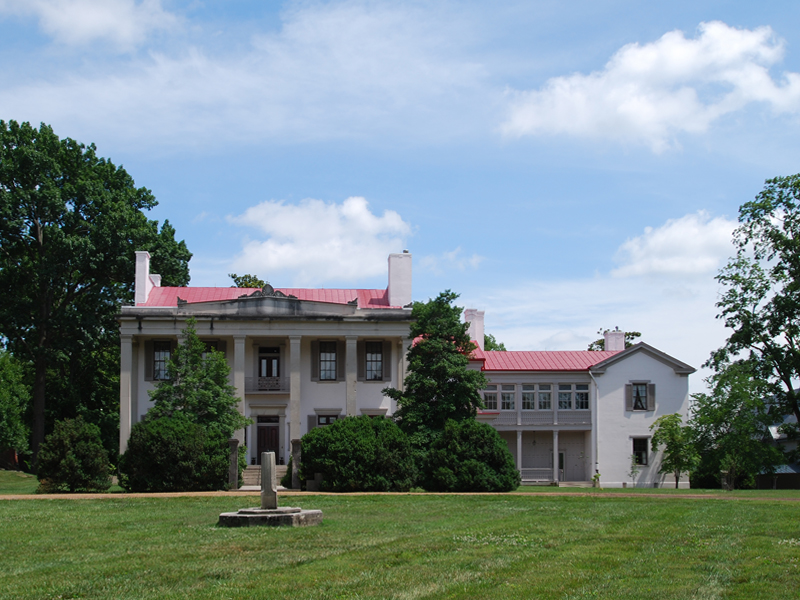
In February 1807, John Harding bought 250 acres on Richland Creek, seven miles outside Nashville. He brought three enslaved people to the property: Ben, Dicey and Patrick. In 1816 he advertised his stallion Boaster for breeding, in effect beginning the thoroughbred business here, and after building a two-story brick Federal-style house from 1819 he named the place Belle Meade, meaning beautiful meadow. His son William Giles Harding enlarged it in the Greek Revival style in 1853 and 1854, and by 1860 he enslaved 136 people. The stallion Bonnie Scotland, bought in 1871, founded a line that the site says includes more than two-thirds of Kentucky Derby winners.
Belle Meade Plantation is a state historic site in Nashville, Davidson County. It is one of 4 state historic sites documented in Davidson County, among 1,301 historic sites cataloged across the county on TennRoam.
The site sits at 36.1065, -86.8673 near Nashville. The nearest cataloged historic site is The Belle Meade Railway Station (historical marker), about under a tenth of a mile away. Others within a short drive include The Natchez Trace, In 1807, and Dairy.
This record is drawn from the State of Tennessee's historic-sites map (TN.gov). Use the map below for its exact position and turn-by-turn directions.
The 1807 purchase included Dunham's Station, a log cabin on the Natchez Trace, and the Hardings also ran a blacksmith shop, cotton gin, and grist and saw mills. William Giles Harding, a Confederate supporter, was arrested after Union forces took Nashville in 1862 and held for six months at Fort Mackinac, Michigan, while his wife Elizabeth McGavock Harding managed the estate. On December 15, 1864, fighting in the Battle of Nashville reached the family racetrack about a mile from the house, and Confederate General James Chalmers used the mansion as headquarters. After emancipation, 72 formerly enslaved people signed paid labor contracts with Harding. His son-in-law William Hicks Jackson bought the stallion Iroquois in 1886; the estate was sold in 1906, and in 1953 the State of Tennessee bought the mansion and deeded it to the Association for the Preservation of Tennessee Antiquities. The house is on the National Register of Historic Places (reference 69000177).
Get TennRoam — 22,000+ historic sites in your pocket
See this site and every marker, battlefield, cemetery, courthouse, museum and landmark across Tennessee on one live map — find what's near you, get directions, and collect sites as you roam.