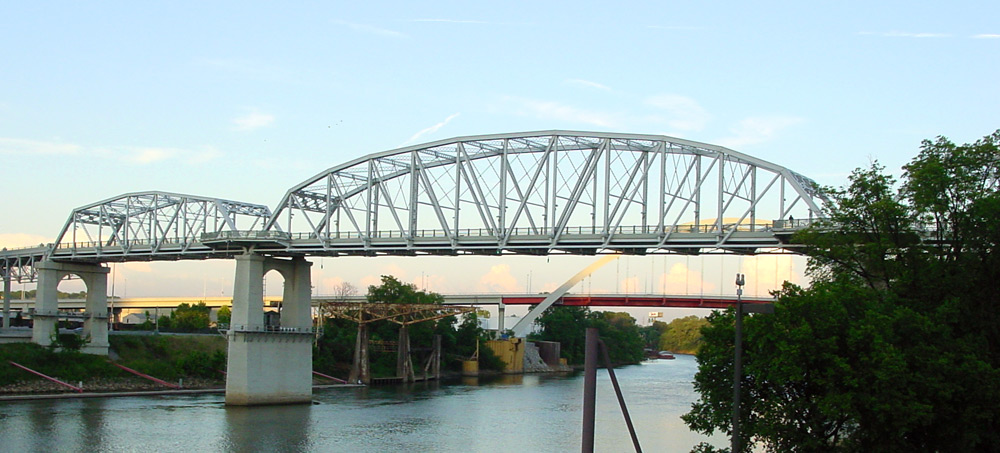
The Shelby Street Bridge, first called the Sparkman Street Bridge, crosses the Cumberland River in Nashville. Built from 1907 to 1909 by Foster-Creighton-Gould under chief engineer Howard Jones, it used trusses of reinforced concrete in new and untested ways, which drew engineering attention across the state and nation. Nashville's population had grown from 40,000 in 1880 to 110,000 by 1910, and the only link to East Nashville, the 1886 Woodland Street Bridge, had become badly crowded. The new bridge helped Nashville grow into a city with suburbs, especially in East Nashville. When nominated it still carried rush hour traffic with no truck weight limits. It was listed for its role in transportation and its engineering design.
Source: National Register nomination 86003237 (NPS)
About this site
Shelby Street Bridge is a historic place in Nashville, Davidson County. It is one of 192 historic places documented in Davidson County, among 1,301 historic sites cataloged across the county on TennRoam.
The site sits at 36.1622, -86.7721 near Nashville. The nearest cataloged historic site is Nashville Bridge Company (historical marker), about under a tenth of a mile away. Others within a short drive include Demonbreun’s Cave, Acme Farm Supply Building, and Surrender of Nashville East Bank of the Cumberland.
This record is drawn from the National Register of Historic Places (Tennessee Historic Preservation Office and National Park Service). Use the map below for its exact position and turn-by-turn directions.
The bridge opened on July 5, 1909, as the Sparkman Street Bridge, at a cost of about $475,000. Howard M. Jones of the Nashville, Chattanooga and St. Louis Railway designed it and oversaw construction. About 3,150 feet long, it is described as the first bridge in North America with concrete arched trusses. Worn concrete was replaced with gunite between 1927 and 1930. State inspectors rated it poor in 1992 and it closed to vehicles in 1998, but instead of demolition it was converted to a pedestrian bridge. The refurbishment, which cost over $15 million, added an elevator, ramps and a bicycle lane, and it was renamed the John Seigenthaler Pedestrian Bridge in April 2014.
Get TennRoam — 22,000+ historic sites in your pocket
See this site and every marker, battlefield, cemetery, courthouse, museum and landmark across Tennessee on one live map — find what's near you, get directions, and collect sites as you roam.