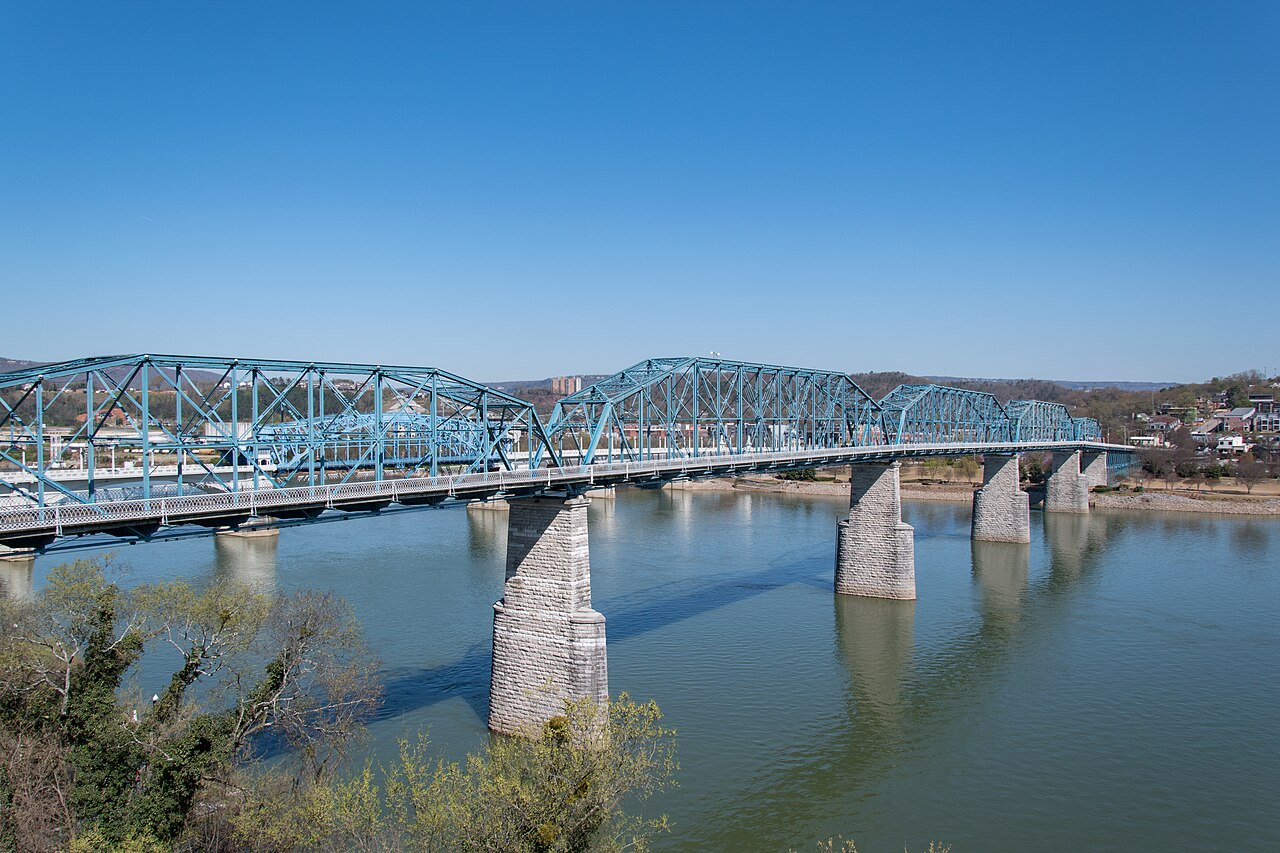
Chattanooga's Walnut Street Bridge, designed by the prominent engineer Edwin Thacher, opened in 1891 and was the city's only bridge across the river until 1917. It joined two parts of the city and encouraged growth on the north side. Before it, residents relied on clumsy ferries, after a military bridge from 1864 collapsed in 1867, weakened by a record flood and, at another time, twenty-five stampeding mules. Its design is a Camelback truss, a variant of the Pratt truss, with spans unusually long for Tennessee. It was then the oldest Camelback truss in the state and close to the thirteenth-oldest of its simple metal truss bridges. It was listed for transportation and engineering.
Source: National Register nomination 90000300 (NPS)
About this site
Walnut Street Bridge is a historic place in Chattanooga, Hamilton County. It is one of 100 historic places documented in Hamilton County, among 583 historic sites cataloged across the county on TennRoam.
The site sits at 35.0585, -85.3072 near Chattanooga. The nearest cataloged historic site is Early Improvements to Tennessee River Navigation (historical marker), about under a tenth of a mile away. Others within a short drive include Market Street Bridge, Late 1800s and Early 1900s Industry in Chattanooga, and Tennesee River Flooding and the First Chattanooga Bridges.
This record is drawn from the National Register of Historic Places (Tennessee Historic Preservation Office and National Park Service). Use the map below for its exact position and turn-by-turn directions.
The Smith Bridge Company of Toledo, Ohio built the superstructure, while Neeley, Smith and Company of Chattanooga built the substructure, with most parts made by Manly Jail Works of Dalton, Georgia, and shipped by rail. Known as the county bridge, it was apparently the first non-military highway bridge across the Tennessee River and linked downtown to the North Shore. Streetcars of the Chattanooga Traction Company also crossed it toward Signal Mountain. Ed Johnson was lynched on the bridge in 1906, a crime that led to the Supreme Court case United States v. Shipp. It closed to motor vehicles in 1978 and was later converted into a pedestrian walkway. Its deck was replaced with wood planking in 2009 and 2010, and it was listed on the National Register on February 23, 1990.
Get TennRoam — 22,000+ historic sites in your pocket
See this site and every marker, battlefield, cemetery, courthouse, museum and landmark across Tennessee on one live map — find what's near you, get directions, and collect sites as you roam.