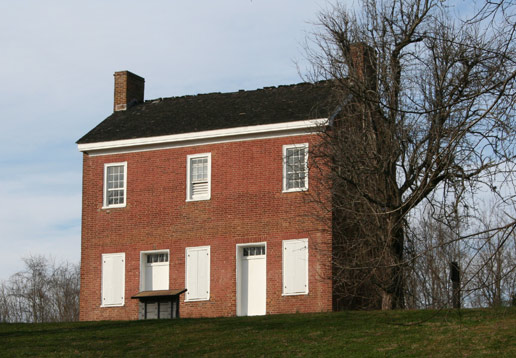
The John Gordon House, near Williamsport on the Duck River close to the old Natchez Trace, belonged to Captain John Gordon and was one of the earliest private brick buildings within thirty miles. Born near Fredericksburg, Virginia, in 1763, Gordon came to Nashville about 1786, defended the Cumberland settlements, and became Nashville's first postmaster in 1796. In 1801 and 1802 he reached an agreement with the Chickasaw leader George Colbert to operate a ferry and trading post at the Duck River, and he later received 640 acres here. He led Andrew Jackson's scouts in the Creek campaign and died in 1819 after the Seminole campaign. His wife began the house in 1817, and it was finished in 1818.
Source: National Register nomination 74000333 (NPS)
About this site
John Gordon House is a historic place in Williamsport, Hickman County. It is one of 4 historic places documented in Hickman County, among 65 historic sites cataloged across the county on TennRoam.
The site sits at 35.7204, -87.2602 near Williamsport. The nearest cataloged historic site is The Family Farm ... Working in Harmony with the Environment (historical marker), about 2.2 miles away. Others within a short drive include Natchez Trace Parkway, Jackson Branch – A Stolen Stream, and Old Trace Walk.
This record is drawn from the National Register of Historic Places (Tennessee Historic Preservation Office and National Park Service). Use the map below for its exact position and turn-by-turn directions.
Dolly and John Gordon moved their large family from Nashville to the Duck River crossing in 1812. Gordon was away serving under Andrew Jackson in the Creek War while the house was being completed, and he is said to have sent building instructions to his wife by letter. He died in 1819, and Dolly continued to run the farm until her death in 1859. The brick house, a Federal-style building with a modified hall-and-parlor plan, was among the finer homes on the Tennessee frontier. Traffic on the Old Trace faded soon after it was finished, but the Gordon ferry kept crossing the Duck River until a bridge replaced it in 1896. After several private owners, the National Park Service acquired the house in 1973 as part of the Natchez Trace Parkway, and the exterior was restored to its 1818 look. It is one of only two surviving structures on the Parkway from the Old Trace era.
Get TennRoam — 22,000+ historic sites in your pocket
See this site and every marker, battlefield, cemetery, courthouse, museum and landmark across Tennessee on one live map — find what's near you, get directions, and collect sites as you roam.